
Our Investment Strategies
The strategy seeks to provide absolute returns through:
CAPITAL GAINS POTENTIAL
The portfolio seeks to achieve price appreciation from the stocks it owns. However, the main objective is income generation.
CASH FLOW POTENTIAL
The portfolio seeks cash flow from dividends, dividend increases and the sale of covered call options. Keep in mind that if the stock price falls, you are still a stock owner and are subject to the full loss of your stock investment, reduced only by the credit received from the sale of the call option. Covered call writing is not an absolute protective strategy. Profit potential is limited to the premium received by the investor. You forgo upside stock price appreciation (above the strike price) if assigned. Also, remember that there are tax considerations to all options transactions and investors considering options should consult with their tax advisors to evaluate how taxes can affect the outcome of various options transactions.
POTENTIAL MODERATION OF VOLATILITY ON STOCK RETURNS
A secondary objective of this strategy is to grow the portfolio over time with less volatility than the Standard & Poor’s 500.
Core Strategy 1 in Action
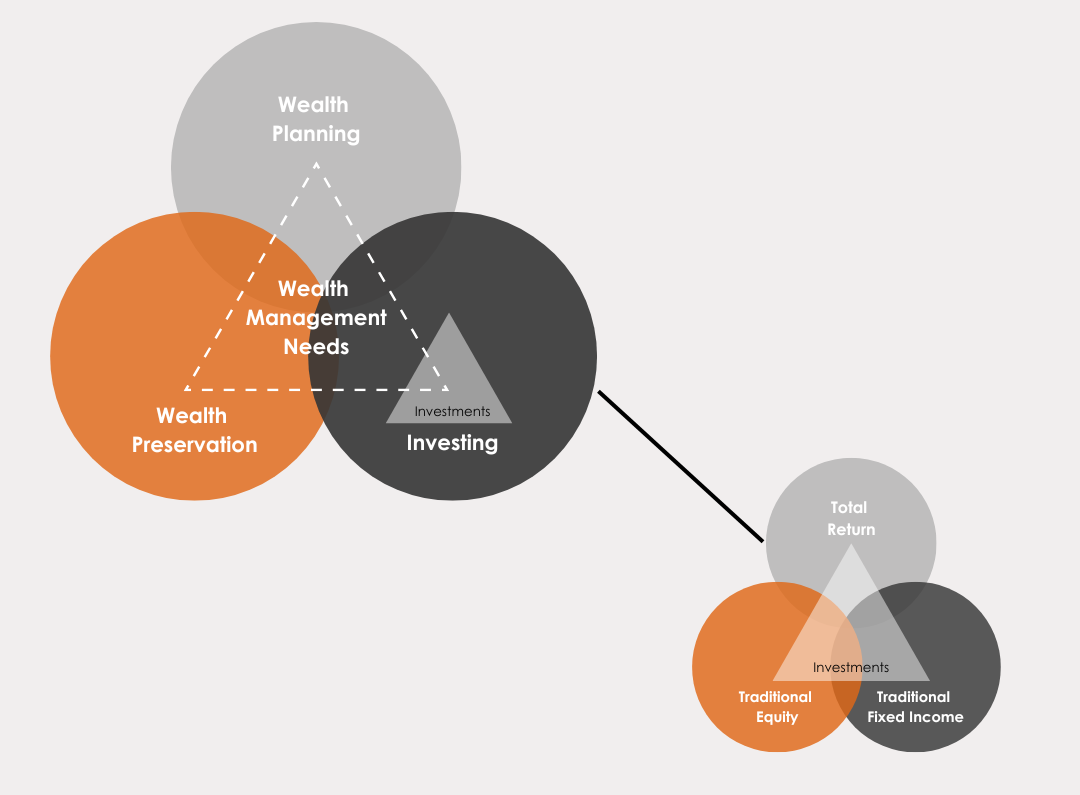
TRIANGLE AND ONE
Your investments are just one critical component of a comprehensive strategy that addresses all of your wealth management needs.
Core Portfolio 2
Like Core Portfolio 1, Core Portfolio 2 can be called an “absolute return” strategy. However, Core Portfolio 2 employs a more aggressive approach. Many of the same disciplines in stock selection and covered call writing used in Core Portfolio 1 are replicated here. However, there are differences:
- Unlike Core Portfolio 1, not all positions have options written against them.
- Some of the companies chosen for the portfolio do not pay dividends
- In an attempt to generate absolute returns, we may establish positions which have short securities within their portfolio. To be clear, this point is not referring to any option strategy.
- Companies with various market capitalizations may be included in the portfolio
As a result, Core Portfolio 2 may be subject to greater volatility than Core Portfolio 1. It is, therefore, only suitable for investors willing to assume greater risk in pursuit of potentially higher returns.
A Closer Look at Option Income Strategies
Imagine you buy or already own a stock that is currently selling at $50 per share. You decide to write or sell an option on your position that gives the buyer the right to purchase your stock by a specific date for a specific price. In this case, let’s say that price is $55 per share. For this right, the buyer pays you a premium. For example’s sake, assume the premium you receive is $5 per share.
HERE ARE SEVERAL SCENARIOS THAT MIGHT FOLLOW:


Core Portfolio 3
Core Portfolio 3 might best be described as a “dynamic income” strategy. Investments selected for the portfolio may span all global bond and fixed income markets, while also including high dividend paying stocks. Specifically, the portfolio may contain utilities, preferreds and REITS, as well as U.S. Treasury Bonds, closed-end bond funds and corporate bonds ranging in credit quality and maturity. This strategy may be appropriate for investors seeking greater diversification, more income and lower volatility than our equity-oriented strategies.